
Choose a question small enough to answer
A neighborhood walk can raise a surprisingly specific historical question. Why does a storefront sit behind the sidewalk line? Was the corner building always used for the same purpose? When did a lane appear between two blocks? Choose one question about one location before collecting an entire folder of interesting images. A narrow question gives each record a job.
This article proposes a small research exercise rather than a finished history of a particular Seattle property. The examples are hypothetical. The aim is to show how a resident can connect records without filling gaps with a plausible story. You should finish with a clear account of what the evidence shows, what it suggests, and what would need another source.
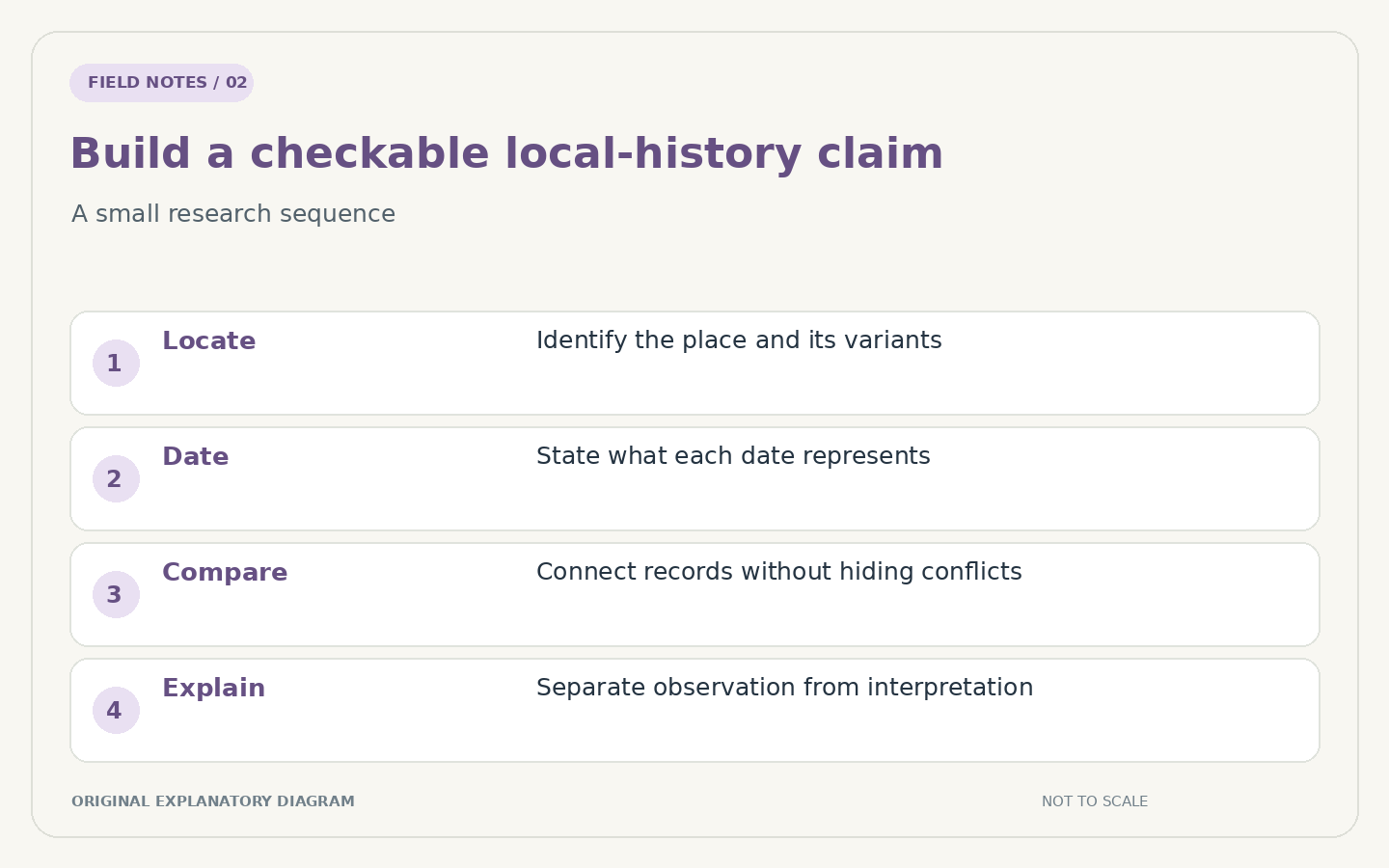
Identify the place in more than one way
Begin with the present address and its surrounding streets, then note any parcel or building identifiers found in reliable records. The Seattle Municipal Archives describes several routes into property research, including assessor information, historical surveys, directories, and photographs. It also warns that street directions have changed and that an address-only photograph search may miss relevant images. [1]
For the hypothetical storefront, keep a location note containing the current address, the corner, and any older wording discovered during research. Do not assume a historical street name refers to the same boundaries as a modern neighborhood label. The note is a way to preserve uncertainty until the records establish the connection. It prevents a promising search result from being accepted simply because its name looks familiar.
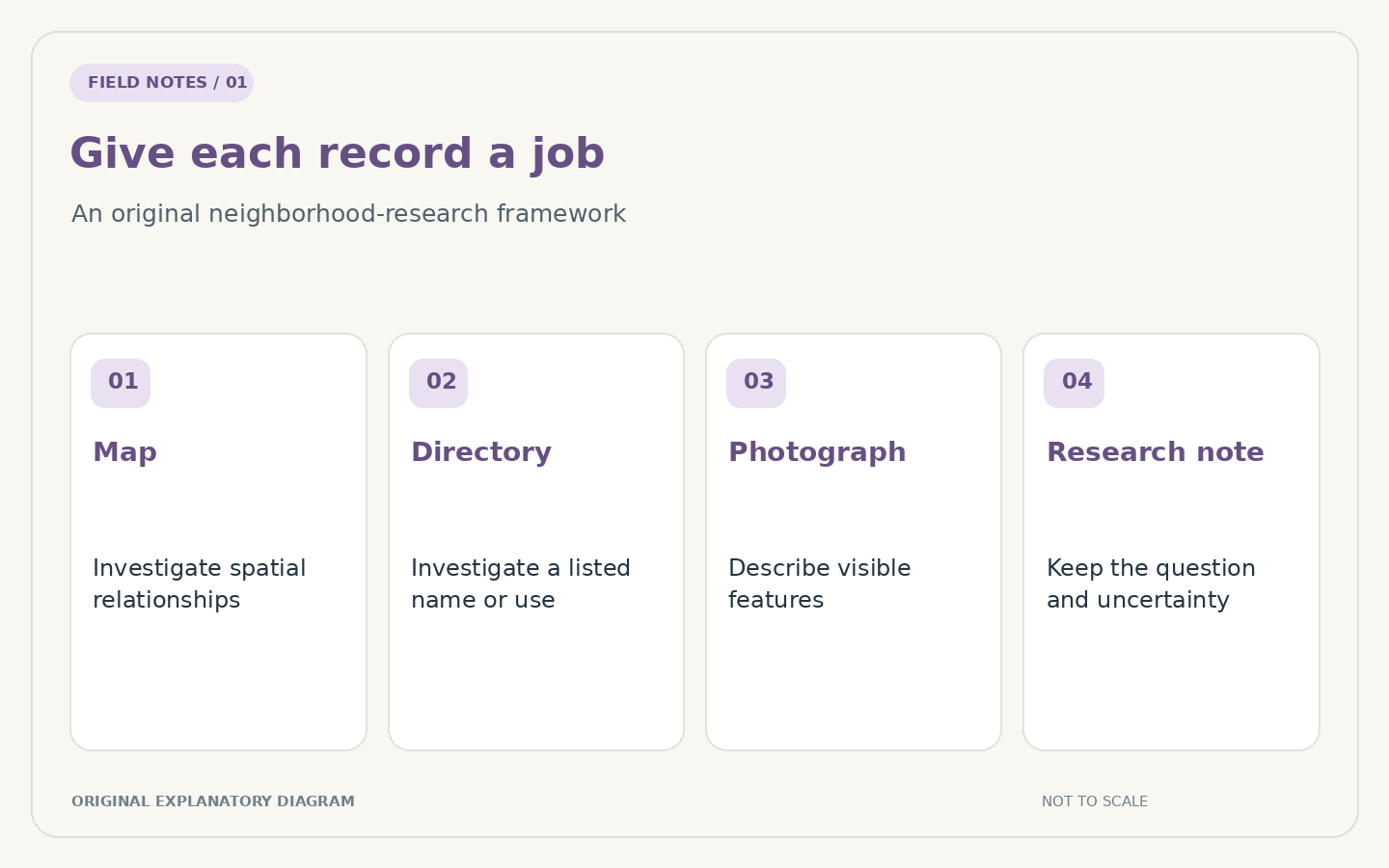
Give each record a different question
A map can help establish the arrangement of streets and parcels at the time it represents. A directory may help investigate a listed occupant or business. A photograph can show visible features from a particular viewpoint. Those are different kinds of evidence. Ask what the record was made to document before using it to answer a question it may not address.
In an original research worksheet, place the question beside the record rather than writing a general summary of everything interesting. The map might answer whether a lane was drawn; the directory might identify a business name; the photograph might show an entrance. Keeping those contributions distinct makes it easier to see where a conclusion depends on more than one source.
Use neighborhood collections as a starting point
The Seattle Public Library's Neighborhood History Project gathers starting points for neighborhood research from library collections and other archives. It also explains that its neighborhood groupings are adapted from the City Clerk's geographic indexing framework. [2] This makes the portal useful for discovery while reminding the reader that a collection's categories are an organizing tool, not the final word on local identity.
Browse around the location as well as searching the exact address. A record may be filed under a nearby street, a broader district, or the public project that prompted its creation. When you find something relevant, retain the collection name and item identifier. That information matters later if you need a better copy, a date clarification, or help interpreting the original description.
Keep the date attached to its meaning
A single record can contain several dates: when an event happened, when the item was created, when it was published, and when a digital copy was added. Record the date that supports the historical claim and label its meaning. An upload date alone does not establish when a building looked the way it appears in a photograph.
If a record gives an approximate date, preserve the approximation. A range can be useful evidence without being forced into a single year. For the fictional storefront question, a photograph may show that an entrance existed by a certain period while leaving its construction date unresolved. That narrower conclusion is more dependable than a precise date inferred only from the age of the surrounding image.
Describe what the photograph actually shows
Look for features that can be stated directly: the number of visible entrances, the position of a sign, a curb line, or the relationship between neighboring buildings. Keep those observations separate from an explanation of why the features existed. A recessed doorway may suggest a design purpose, but the photograph alone may not establish that purpose.
Also notice what lies outside the frame or behind an obstruction. An absent feature in an image may simply be out of view. When comparing two photographs, check whether they face the same direction and show the same part of the property. A careful caption can explain the viewpoint and the unresolved question without pretending that the image supplies a complete building history.
Let conflicting records remain visible
Two sources may seem to disagree because they describe different periods, use different identifiers, or record different aspects of the same place. Before choosing one, write down the disagreement precisely. A directory listing a business at an address is not necessarily describing property ownership, and a later description may summarize an earlier use without preserving every change.
Make the next search answer the conflict rather than simply add more material. You might need a record closer to the date, a clearer address reference, or an explanation from an archivist. If the question remains unresolved, say so in the final account. A small piece of honest uncertainty is preferable to a smooth narrative that hides the point where the evidence stopped.
Make a short account someone else can check
Write the conclusion as a sequence of supported statements. Identify which record shows the feature, which record adds context, and which interpretation remains tentative. Keep the item identifiers near your working notes so a later reader can follow the same path. The finished account should not depend on remembering which file had the interesting photograph.
If you share an image, check the collection's stated reproduction and credit information rather than assuming all historical material has the same conditions. A citation also helps neighbors correct or extend the account. The goal is a usable piece of local history: small enough to verify, clear about its sources, and open to evidence that may refine the initial conclusion.
Return to the block with a better question
A second visit can help you notice a feature you overlooked, but present-day observation should remain separate from the historical record. A modern alteration cannot prove when an earlier change occurred. Use the visit to refine the question, compare visible relationships, and identify which part of the story still deserves research.
You may end with a modest result: a business name associated with a particular period, an entrance visible in a dated image, or a lane shown on one map but not another. That is worthwhile. Neighborhood history grows from such specific connections, especially when the researcher preserves the limits that allow someone else to investigate the next question.
Sources
- Resources for Property History Research — Seattle Municipal Archives
- Neighborhood History Project — The Seattle Public Library


Beautiful Seattle
Plane producer Boeing opened in 1916 in a previous shipyard on the shores of Lake Union. World War I kickstarted the trade, but the taking after a long time were inclined ones, and Boeing started turning out furniture, phonograph cases, and girdle outlines to balanced the decrease. The rise of commercial flying, World War II, and the fly age would inevitably move the company into the stratosphere. And in spite of the fact that it’s now not is based in Seattle, Boeing still producers a few airplanes, counting the 747, then 767, and the monster 787 Dreamliner, at the company’s Everett plant fair north of Seattle.